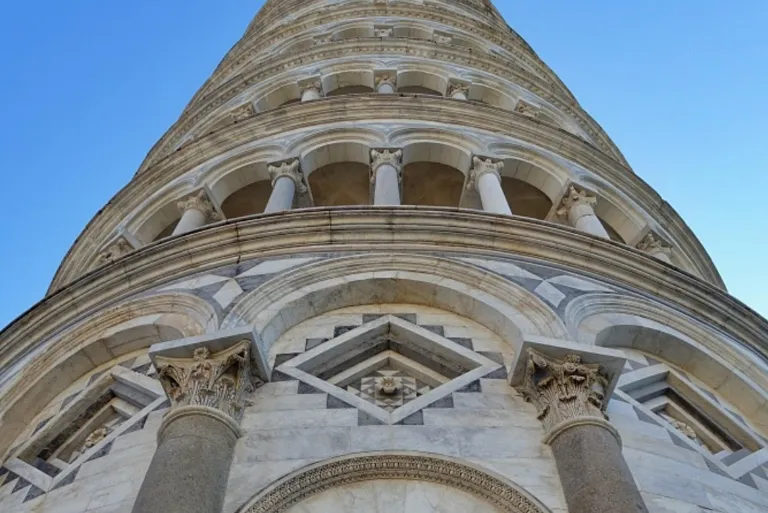
There are some European sights that are well known across the world, and the famous Leaning Tower of Pisa is among the greats that grace the postcards. To be able to visit the Leaning Tower of Pisa and see it in all its wonky glory is really cool, but you can go one step further and climb to the top of the popular landmark.
Climbing the Leaning Tower of Pisa is one of those experiences that’s even more interesting than you initially think. Taking pride of place in the heart of Pisa, this iconic tower’s unique slant gives a quirky twist to every step you take up the spiral staircase.
It’s a mix of history, confusion over climbing stairs but feeling like you’re on the flat, and stunning panoramic views that make climbing the Leaning Tower of Pisa truly unforgettable.
History of the Leaning Tower of Pisa
Pisa’s famous tower started life back in 1173. Originally designed to be a freestanding bell tower for the adjacent Pisa Cathedral, it quickly became apparent that something wasn’t quite right. By the time they reached the third storey, the ground beneath the tower had started to sink, causing the start of that now-famous lean. They stopped building, and it took 100 years for the land to settle and before work restarted.
Fun fact: Pisa was named in 600BC from the Greek for ‘marshy land’. Explains why the land might not be great for huge towers!
Work on the tower was completed in 1372, and although the tower continued to tilt, it did so at a much slower rate than it had previously. It’s believed that the full weight of the building may have helped, but it got to a point in 1835 where they realised some intervention was required to stabilise the building. The result was a dashing marble base which replaced a lot of the muddy soil that had been sat under the tower.
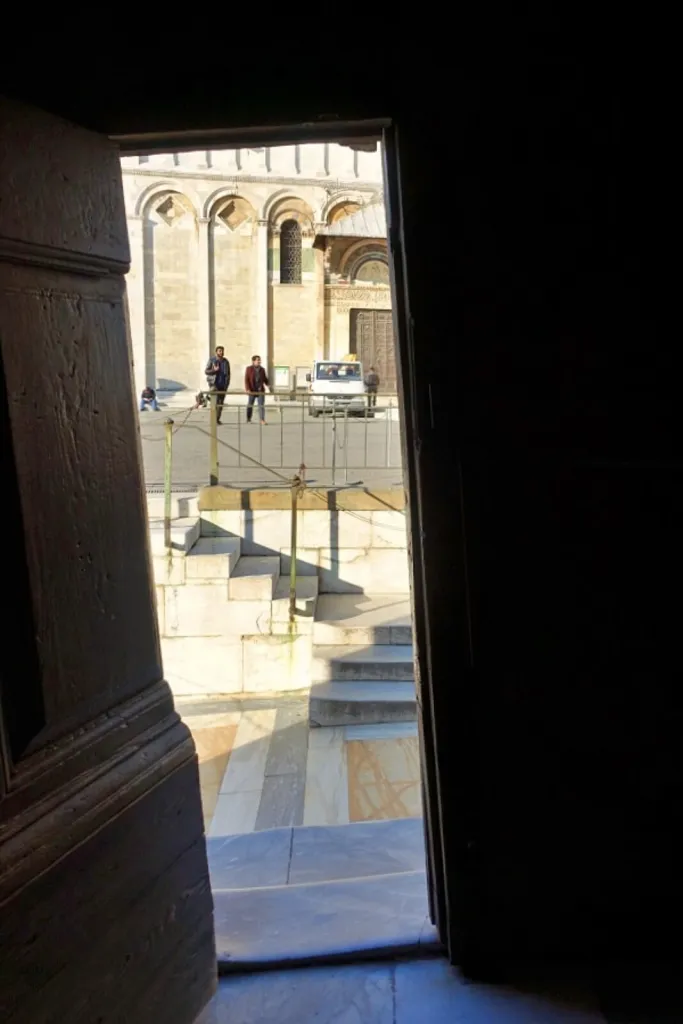
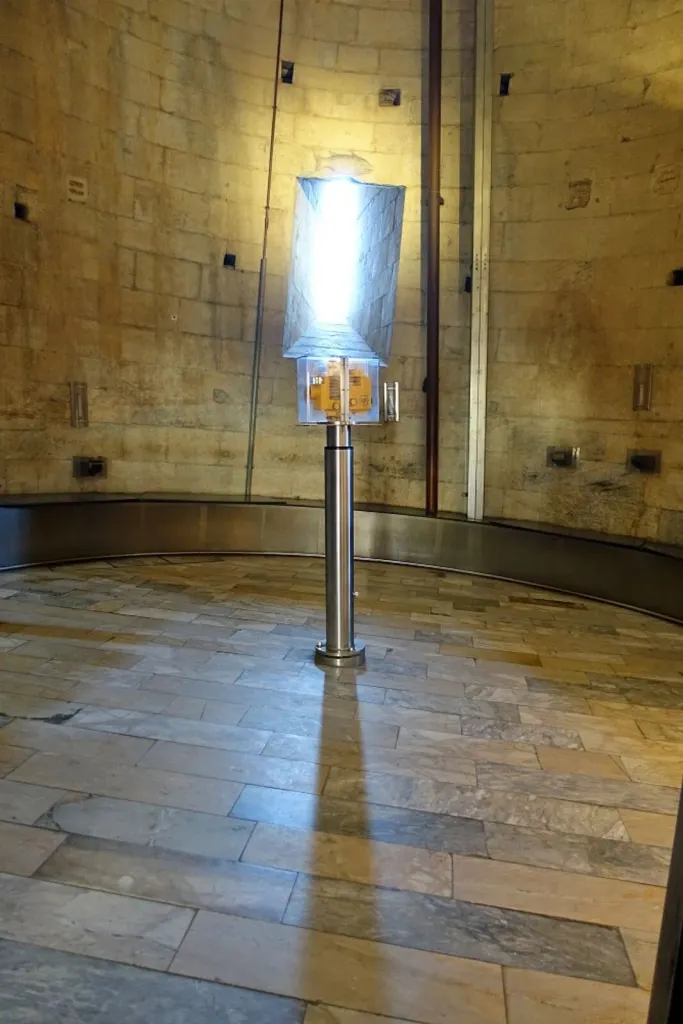
The new base helped massively, but the government had to yet again request help to stabilise the tower in 1964. In an ever-ongoing challenge, the tower was closed in 1990 as a safety measure before reopening in 2001 after its latest restructuring project.
During this time, the tower, along with the other buildings in Cathedral Square, was declared Patrimony of the Humanity by UNESCO.
Climb the Leaning Tower of Pisa
If you’re tight on time then being able to just see the tower is pretty cool. It’s architecturally gorgeous and feels like a mind bend that it’s structurally safe. But if you have the time and ability to climb the tower, it’s absolutely worth doing!
There’s a very strange feeling when you make your way up the Leaning Tower of Pisa. The stairs wind around the inside of the tower, and you’ll find that when you are climbing the stairs going with the lean of the tower it takes very little effort and actually feels like the steps are tiny. When climbing against the lean of the tower the steps feel much steeper than usual and it’s harder to climb than a normal set of stairs.
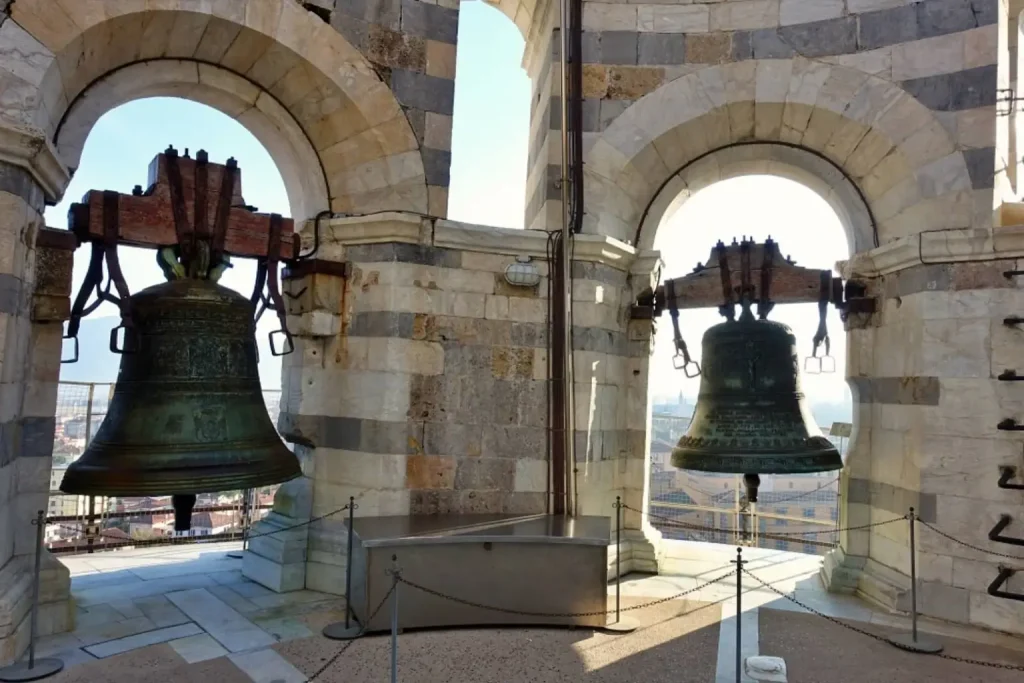
Once at the top of the tower, you can walk around the rooftop. Again, it feels strange as though you are sometimes walking uphill and other times that you are walking downhill even though in your mind you expect to be flat. Be sure to check out the slant of the bells that you would usually expect to sit centrally in the gaps built for them.
Although the climb and walking around feel a little…wonky…it’s definitely an experience and the views from the top of the Leaning Tower of Pisa make the climb very worthwhile. On a clear day you can see for miles, and it’s also very amusing to see all the people on the ground in the iconic push pose as if they are holding up the tower. From the top of the tower though it just looks like hundreds of people lining up waiting for a high five!
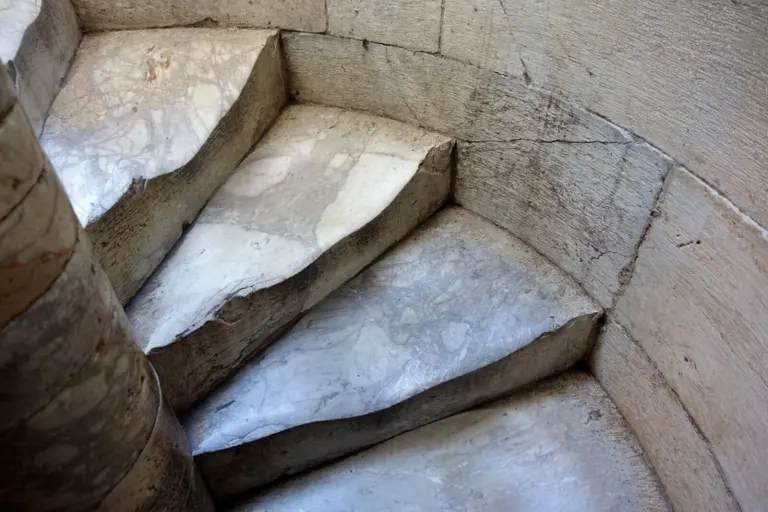
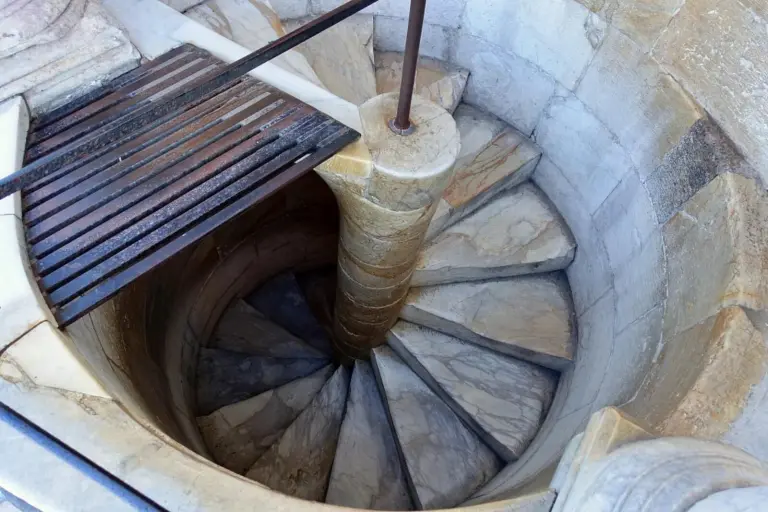
If you have mobility issues or aren’t able to climb a lot of steps with minimal breaks, this probably isn’t an activity for you. The staircase wasn’t built for masses of people, hence the timeslots to control capacity, and as such it’s not the easiest climb to just be able to take at your own leisurely pace without affecting other people. The stairs are also worn where they’ve been climbed for hundreds of years, so attention is definitely required as you go up and down.
Buy Tickets
Tickets for the Leaning Tower of Pisa are allocated to a time slot to control the number of people in the tower at one time. You can buy a ticket for just the tower and cathedral, or for a small amount more buy a combo ticket for all of the 5 main sights in Pisa; the Tower, Baptistery, Cathedral, Cemetery, Opera del Duomo and Sinopie Museum.
It is recommended to buy your ticket in advance to ensure there’s a time slot to climb the tower. All other sites on the ticket can be visited as and when you like in the day. When you buy your ticket, make sure there’s the option to book a time slot at the same time otherwise your ticket isn’t worth much at the tower.
Tickets are available from the ticket office if you haven’t bought them in advance, subject to availability.
Please note: children under 8 are not permitted to climb the tower. Visitors aged 8-18 require an adult to accompany them.
Best Time to Climb the Tower
Pisa is a popular day trip destination, meaning the middle hours of the day are the busiest once all the tour buses and day trippers have arrived. If you’re visiting for the day, it’s best to get to Pisa as early as possible and book the earliest slot to climb the tower. The tower will be quieter at this time, your time slot is less likely to be full because you’ll be there before the day trippers and you’re then free to enjoy the rest of your day without clock watching.
If you can’t get an early slot, then timing your climb with the sun going down is the next best option. The views from the top of the tower are gorgeous over the Tuscan countryside, and seeing that with a beautiful sunset would be just breathtaking.
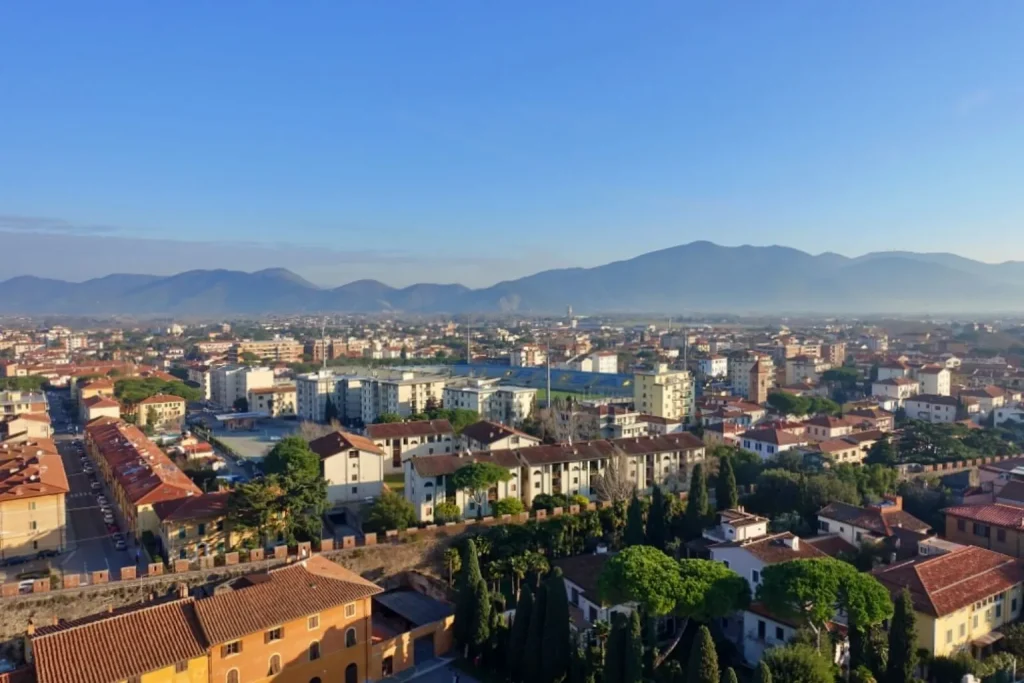
While early or late slots are preferable to avoid the day tripper crowds, the reality is that you may be visiting Pisa on a day trip and are limited on times. In this case, it’d be best to book the middle of the day slot to avoid any delays you may encounter getting to Pisa – if you miss your slot you may not be able to reschedule.
Take the Iconic Photos
Have you even been to Pisa if you didn’t get a photo of you trying to hold the tower up?
Chances are you’ll easily find where to take these photos due to the crowds, but make your way to Piazza del Duomo (the road just south of the complex) to have a photo as if you’re holding the tower up, or to Via Cardinale Pietro Maffi to take a photo looking like you’re trying to blow the tower over.
Height of the Leaning Tower of Pisa
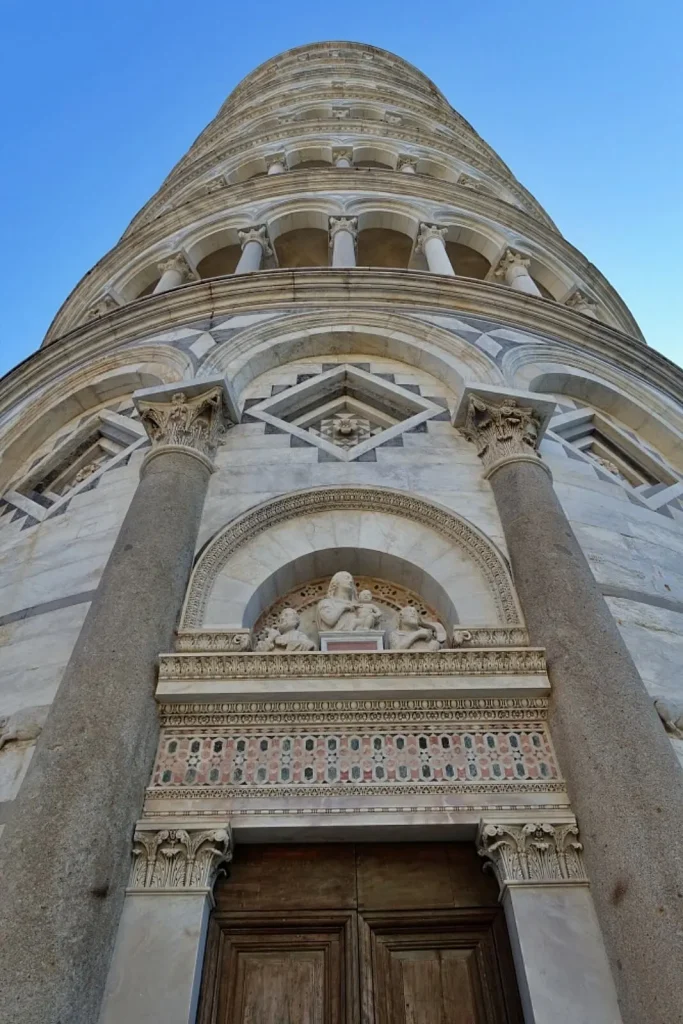
The tower height varies depending which side you measure – y’know, what with the lean and everything – but the 8 floors rise up a maximum height of 55.86m. If you’re planning to climb the Leaning Tower of Pisa, you’ll have over 250 steps to tackle before you get to the top.
To put those 250+ steps into context, if you climb the stairs to the first floor of the Eiffel Tower, that’s 327 steps. If you’ve just been to Florence and climbed the bell tower there, that’s a staggering 414 steps, so Pisa’s tower will be easy in comparison!
The step count for Pisa’s tower vary depending on who you ask, but that’s because there are the internal staircase stairs, but there are also steps to get into the tower, and additional steps when you get to the top to get out and see the views from the very highest point of the tower. It’s best to expect about 300 steps in total.
What Else to Do in Pisa?
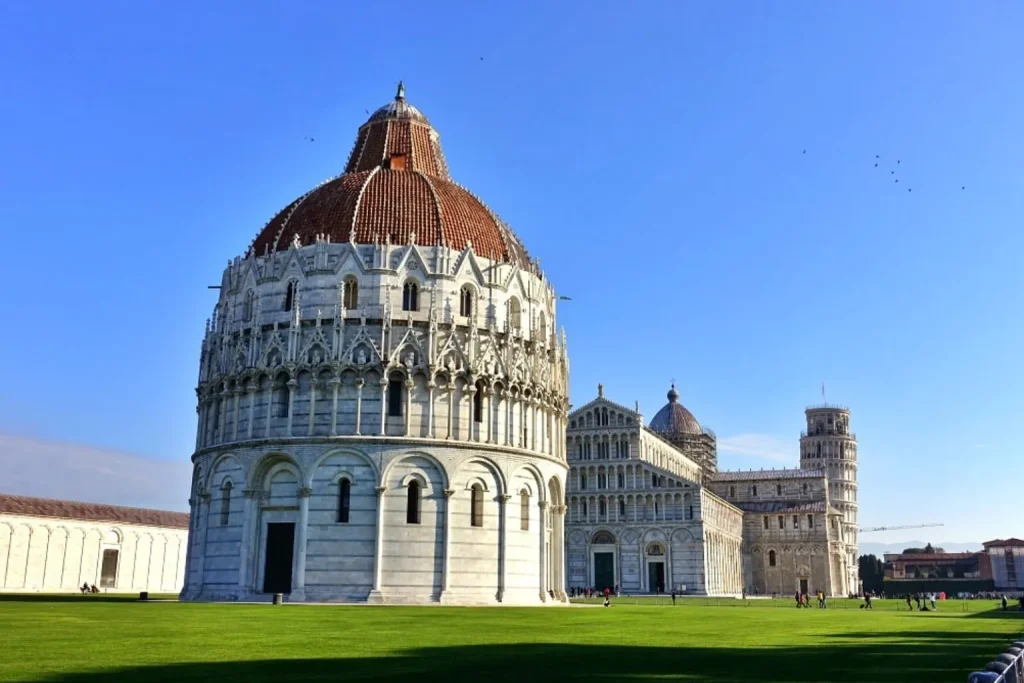
Pisa is a compact city and you can easily see the highlights in a couple of hours. The main sights visitors flock to the city for are all in one square, Piazza dei Miracoli. You’ll find Pisa Cathedral alongside the Leaning Tower of Pisa, the Baptistry, Sinopie Museum and the ornate cemetery. They’re easy to see quickly from outside, or combination tickets are available to go inside them all.
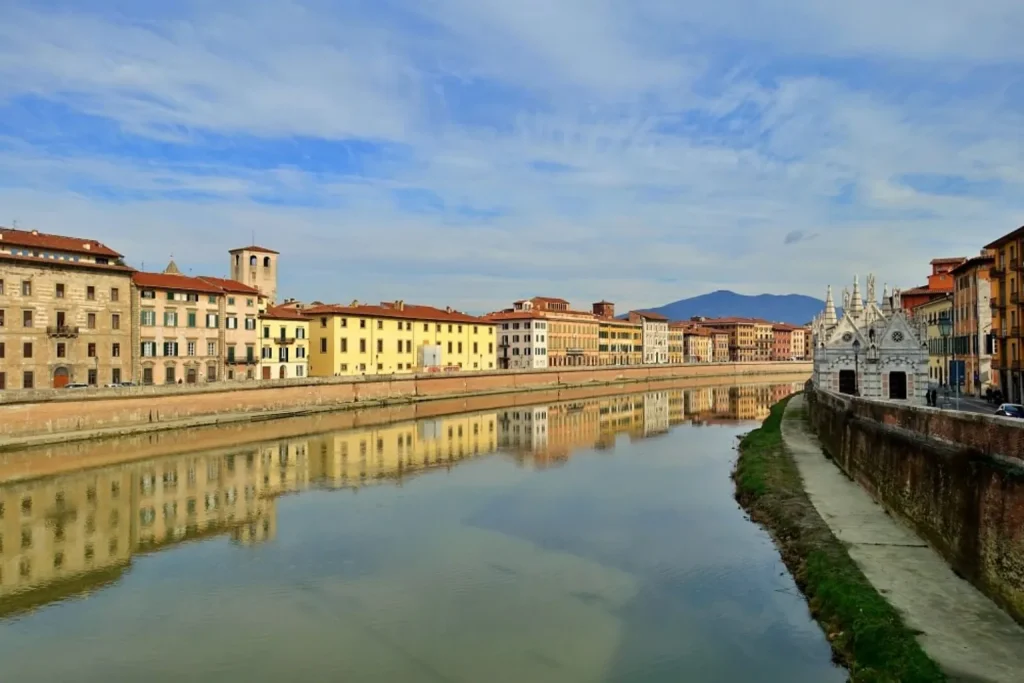
Away from the tourist sites in Piazza dei Miracoli, Pisa has a number of other spots that are worth checking out. There’s Iglesia de Santa Maria della Spina on the banks of the River Arno, a small church but worth popping by if you’re walking from the train station to Piazza del Miracoli. The view from the river as you cross by the church is also really pretty and worth checking out on a sunny day.
Fans of art will enjoy walking past Tuttomondo, a wall mural by Keith Haring completed in 1989. It’s on the back of a church, yet another to have a look at if you’re a fan of religious buildings.
Aside from these few additional sights, there’s not a huge amount of ‘things to see’ in Pisa, but it’s a lovely city to wander and check out the cafes and charmingly colourful streets.
If you have a full day in Pisa and see everything in the morning, there’s a thermal spa in a town close by that you could spend the afternoon in. You’ll need to catch an additional train to get to Bagni di Pisa, but it’s one of the few thermal spas in Europe, and is housed in a grand hotel. You’ll find multiple spa pools to explore in the sleepy little town, just be sure not to miss the not-so-frequent train running back to Pisa!
Where is the Leaning Tower of Pisa?
Would you believe it…Pisa!
Pisa is a small city in Italy, in the gorgeous Tuscany region of the north. It’s about an hour from Florence, but has its own airport and multiple train stations. Once you’re in Pisa, it’s fairly easy to find the tower because it’s usually a case of ‘follow the crowds’ but if you’re lucky enough to miss the crowds then just head for Piazza del Duomo. You’ll spot the tower soon enough once there!
How to Get There
Train: Pisa train station is easily accessible from Florence and Rome, with those cities both being large transport hubs offering access to other cities in Italy. The most popular route by train is Florence to Pisa (Firenze SMN to Pisa Centrale) taking about 1hr 20 minutes.
Organised day trip: Pisa is a popular day trip choice, so you’ll find a wide range of organised day trips. Many will pair Pisa with one or more other cities, and while it can be tempting to squeeze in as much as possible in one day, you’ll want to make sure you have at least a couple of hours in Pisa to see the main sights. If you have all day to spend in Pisa, it’s a lovely city to have a wander and explore the sleepy streets.
Tower of Pisa Links with Galileo
As if the Leaning Tower of Pisa isn’t famous enough, it has links with the Italian scientist, Galileo Galilei. He studied at Padua University, made great strides in Physics and is believed to have held an experiment at the tower to prove his theory that objects of different weights fall at the same speed.
I’ll be honest, this isn’t a science site for a reason but other people do explain the experiment very well. But, it is quite interesting and adds an extra point of interest to the tower, so fun for us non-sciencey people too!