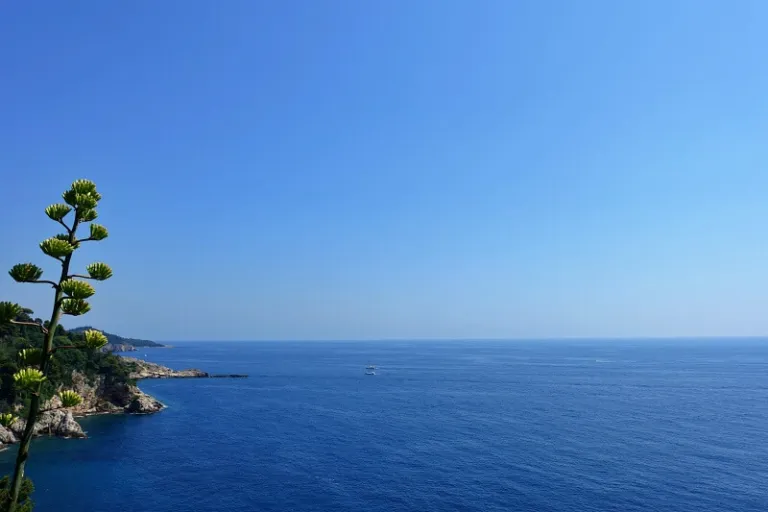
Mount Tibidabo rises 512 meters above Barcelona, making it the highest point in the Collserola range that frames the city to the northwest. On clear days — more common from October through February — the view reaches the full Mediterranean coastline and, on exceptional winter mornings, as far as the Balearic Islands. Getting there involves three separate transit connections, and the logistics trip up more visitors than the climb itself.
How to Reach Mount Tibidabo: Your Transit Options Compared
There is no single direct route from central Barcelona to the summit. The standard approach chains the FGC railway, the historic Tramvia Blau, and the Funicular de Tibidabo — three vehicles, three ticketing systems, approximately 45-60 minutes door-to-door from Plaça Catalunya. Here is how the full route breaks down.
| Segment | Transport | Cost (one way, 2026) | Approx. Duration |
|---|---|---|---|
| Plaça Catalunya → Av. Tibidabo | FGC Line S1/S2 or TMB Metro L7 | T-Casual card (~€1.10/trip) | ~10 min |
| Av. Tibidabo → Peu del Funicular | Tramvia Blau (seasonal weekends/holidays) | €6.50 single / €10.50 return | ~20 min |
| Av. Tibidabo → Peu del Funicular (alt.) | Bus 196 (when tram not running) | T-Casual card (~€1.10/trip) | ~20 min |
| Peu del Funicular → Summit | Funicular de Tibidabo | €7.70 single / €4.10 with park ticket | ~5 min |
The Tramvia Blau — Barcelona’s last surviving historic tram line, running since 1901 — operates on a limited seasonal schedule. It typically runs on weekends and public holidays when the amusement park is open. On weekdays and outside peak season, Bus 196 covers the same route. Less charming, but fully reliable and covered by the standard T-Casual card.
The T-Casual card (10 integrated trips, approximately €12.15 in 2026) covers the FGC trains, TMB Metro, and Bus 196 legs of the journey. It does not cover the Tramvia Blau or the Funicular de Tibidabo — those require separate tickets purchased at each boarding point. For visitors spending more than two days in Barcelona, the T-Casual generally offers the best per-trip value across the full transit network.
Can You Drive or Take a Taxi to Tibidabo?
Driving is possible but not generally recommended. Parking near the summit is limited, and the access roads — including Carretera de les Aigüles — are narrow and occasionally restricted on high-traffic days. Rideshare services including Cabify and Bolt operate throughout Barcelona and can drop passengers at the funicular base at Peu del Funicular. Expect to pay roughly €12-18 from central Barcelona depending on time of day — a practical option for anyone who finds the transit chain complex.
FGC vs. TMB Metro: Which Line Gets You There?
Both serve Avinguda del Tibidabo station — the stop you need before taking the tram or bus uphill. The FGC S1/S2 lines depart from the lower-level FGC concourse at Plaça Catalunya — a separate entrance from the Renfe and TMB Metro levels, on the west side of the square. The FGC concourse sits one additional level below the standard Metro platforms, marked with a green diamond logo. Most visitors who miss the connection are confused by this separation — the FGC entrance is easy to walk past if you’re scanning for standard Metro signage.
Inside Tibidabo Amusement Park: What You’re Actually Paying For
Parc d’Atraccions Tibidabo opened in 1901 and is one of the oldest continuously operating amusement parks in Europe. That age is central to its character. Unlike parks built around branded IP or imported roller coaster inventory, Tibidabo’s identity is the mountain itself — the views, the architectural oddities, and a combination of vintage and modern attractions that has no real parallel in Spain.
The park runs on a two-tier ticket structure. The Sky Walk ticket (approximately €16.50 in 2026) covers the lower section — panoramic terraces, the Museu d’Autòmats, and a selection of smaller rides and scenic attractions. The full park ticket (approximately €35 for adults, €26 for children under 1.20 meters) covers all rides across both levels. Children under 90cm enter free.
The Museu d’Autòmats deserves specific mention. It holds one of Europe’s largest collections of coin-operated mechanical automata — fortune tellers, miniature mechanical theatres, coin-operated orchestras — dating from the 1880s onward. Most pieces still function. It tends to stop adults mid-stride, which is an unusual quality for any amusement park exhibit.
Is the Full Park Ticket Worth It for Adults Without Children?
Probably not. Tibidabo’s ride inventory runs to approximately 25-30 attractions across both zones. Several of the more substantial rides have height minimums that skew toward children, and the overall atmosphere is geared toward families. Adults visiting solo or as a couple typically find the Sky Walk ticket sufficient for the terrace views, the Autòmats museum, and rides like the Avió biplane — a 1928 original that revolves suspended above the city.
If the goal is ride intensity, PortAventura World in Tarragona — about 100km south of Barcelona, reachable in roughly 1.5 hours by regional train — is a categorically different park. It has 39 attractions including Dragon Khan (a steel hypercoaster with 8 inversions), operates year-round, and is built around scale and thrill. Tibidabo is not competing in that space. Buying the full ticket while expecting that experience will likely result in disappointment.
When Is Tibidabo Actually Open?
Parc d’Atraccions Tibidabo does not operate daily or year-round. The park typically runs from late March or April through early January, and within that window it often operates only on weekends outside of summer. During June through mid-September, opening days are more frequent. The specific calendar is published annually on the official Tibidabo website. Relying on general seasonal expectations — rather than the current published schedule — is the single most commonly reported cause of a wasted trip to the summit.
Tibidabo Views vs. Bunkers del Carmel: Which Is Actually Better
For panoramic views alone, Bunkers del Carmel is the stronger choice — and it costs nothing.
The Bunkers del Carmel are the remains of an anti-aircraft battery from the Spanish Civil War, located in the Carmel neighborhood above Gràcia. They offer a genuine 360-degree panorama of Barcelona with no entry fee, no funicular, and no tram logistics. Getting there typically requires a Metro ride to Alfons X (L4, green line), then a 10-15 minute uphill walk. The site is generally accessible at most hours without any ticketing structure.
Tibidabo sits higher — approximately 512 meters versus around 300 meters for Bunkers — but the added elevation doesn’t dramatically transform the visible city below. What it does add is greater reach on the northern horizon: on a clear day from Tibidabo, the Pyrenees appear in a way they don’t from the Bunkers. On exceptional visibility days, typically in late autumn or winter, the Balearic Islands are visible to the southeast at roughly 180km. These are meaningful differences for serious photographers or clear-sky winter visits. For most visitors on a typical afternoon, the view quality is broadly comparable.
The practical distinction: Tibidabo is a destination with a full half-day of activities; Bunkers del Carmel is a viewpoint that takes about an hour total. If the purpose of your visit is specifically to look at Barcelona from elevation, go to Bunkers. If you want a place to spend most of a day — with a park, a historic church, a museum, and a particular kind of old European atmosphere — Tibidabo earns the travel time.
Pricing at a Glance: What to Budget for a Tibidabo Day
| Item | Price (2026 approx.) | Notes |
|---|---|---|
| Full Park Ticket — adult | €35 | All rides and attractions included |
| Full Park Ticket — child under 1.20m | €26 | Height-based, not age-based |
| Child under 90cm | Free | No ticket required |
| Sky Walk Ticket — adult | €16.50 | Views + Autòmats museum, no major rides |
| Tramvia Blau — single | €6.50 | Seasonal; weekends and holidays typically |
| Tramvia Blau — return | €10.50 | Worth buying if you plan to ride both ways |
| Funicular de Tibidabo — with park ticket | €4.10 return | Discounted when bundled with park entry |
| Funicular de Tibidabo — without park ticket | €7.70 single | Purchased separately at base station |
| Temple Expiatori elevator (upper terrace) | ~€5 | Church ground floor is free |
Day visitors can typically cover the full Tibidabo experience — park, church terrace, and return transit — for under €65 per adult, including all transport segments and the church elevator. Budget closer to €90-100 if traveling with children purchasing full park tickets. All prices listed here are approximate for 2026 and are subject to change; verify current rates on the official Tibidabo website before your visit.
Booking online through the official Tibidabo website generally costs slightly less than purchasing at the gate and guarantees entry on busy days — the park does sell out during summer weekends and August public holidays. The Barcelona Card tourist pass does not cover Tibidabo park admission, though it covers some transit segments. The T-Casual card covers the FGC and Bus 196 legs of the route to the funicular base.
The One Decision That Determines Your Whole Day
Check the park operating calendar the night before. Tibidabo is closed more days than it’s open across the full calendar year, and no amount of transit planning or budget preparation compensates for arriving at a locked summit.
Six Things That Commonly Go Wrong at Tibidabo
- Arriving on a closed day. The operating schedule is not posted at transit stations and is not consistent from week to week outside summer. Verify on the official Tibidabo website — not on aggregator travel sites, which frequently carry outdated schedules — the day before your visit.
- Missing the Tramvia Blau cutoff. The historic blue tram stops running in the early evening — typically by 8pm even in summer. Missing the last run means a longer wait for the less frequent Bus 196. If you plan to stay for sunset, confirm the last tram departure time on the day of your visit.
- Underestimating transit time. The full connection from central Barcelona takes 45-60 minutes in practice. Most visitors who rush are those who budgeted 30 minutes. Account for the FGC connection at Plaça Catalunya, which involves locating a concourse that many first-time visitors walk straight past.
- Visiting during summer heat haze. In July and August, afternoon visibility frequently drops to the point where the Mediterranean disappears entirely from the summit view. The panorama Tibidabo is known for is typically at its sharpest from October through February — specifically on cold, clear days when the air is still and the Pyrenees are visible to the north.
- Buying the full park ticket at the gate. Gate purchase is inflexible. If you arrive and decide the Sky Walk covers what you actually want, you’ve already overpaid. Buying online in advance costs slightly less and lets you select the right ticket tier before committing.
- Skipping the church elevator. The Temple Expiatori del Sagrat Cor sits directly at the summit, and most visitors photograph it from the park grounds and move on. The elevator to the upper terrace — approximately €5 — takes you to the highest publicly accessible point on the mountain, above the park’s own Talaia observation tower. The terrace is consistently less crowded than the park’s lookout decks and offers a broader northward view toward the Pyrenees.
The Temple Expiatori del Sagrat Cor: Practical Questions
Is the church free to enter?
The ground floor and lower crypt of the Temple Expiatori del Sagrat Cor are free to enter without reservation. Construction began in 1902 and the building remains officially incomplete — which gives the interior an unusual, unfinished quality that is genuinely worth seeing. The elevator to the external upper terrace costs approximately €5 per person as of 2026. Mass is celebrated daily; visitors present during services are expected to observe silence and appropriate dress. Outside service hours, the church is generally open to visitors throughout the week.
What can you see from the upper terrace?
The main tower rises approximately 75 meters above the church’s base, which itself sits near the Tibidabo summit at 512 meters elevation. On a clear day, the view north typically includes the Pyrenees. To the southeast, on optimal visibility days — generally autumn and winter mornings — the Balearic Islands are visible at roughly 180km. The view differs from the amusement park’s Talaia tower primarily in its openness: the church terrace wraps the full exterior of the tower with no glass panels or wind barriers that partially obstruct the park’s own observation deck.
How long should you budget for the church visit?
Budget 30-45 minutes including elevator wait time and time on the terrace. A ground-floor-only visit takes 15-20 minutes. The church and amusement park share the summit area and can be visited sequentially without any additional transit. Most visitors find that adding the church extends a park day by 45-60 minutes — and it is widely considered a worthwhile addition, particularly for the terrace view, which is distinct from anything the park itself offers.
Check the park’s operating calendar before you make any other plans for the day — everything else about Tibidabo is manageable, but arriving at a locked summit is the one mistake with no on-the-spot fix.