Visiting a new country and seeing the sights is a great passion for many of us, and being able to take a step further and learn about the customs, culture and religious traditions of a country is even better. And luckily for us, Spain has so much culture to learn about!
Semana Santa is just one element of Spanish culture, deeply rooted in religion. In fact, it’s the Holy Week processions that take place across a lot of the country in varying degrees of intensity. In the more religious parts of the country, you won’t be able to escape the parades, while in larger cities like Madrid you could easily miss any hint of Semana Santa and just enjoy a normal week sightseeing.
Having been and experienced Semana Santa in Spain, it’s definitely something I’d recommend that both religious and non-religious people interested in culture should try to see. If it’s not something you’ve heard about or are overly familiar with, then no problemo, this post has you covered!
Semana Santa in Spain
What is Semana Santa?
Semana Santa translates as ‘Holy Week’, and refers to the week-long religious celebrations for and around Easter. The dates change each year according to when Easter falls on the calendar, but it includes Maundy Thursday, Good Friday and Easter Sunday.
Although I was familiar with Good Friday and Easter Sunday growing up, I’d never heard of Maundy Thursday until I was in Spain for Semana Santa, and it’s one of the biggest celebration days there. Don’t be fooled into thinking Semana Santa is just a few days, it’s a whole week of celebrations and parades, peaking from Maundy Thursday onwards.
Semana Santa officially runs from Palm Sunday to Easter Sunday. These dates vary each year, but:
Easter 2025: Sunday 13th April – Sunday 20th April
Easter 2026: Sunday 29th March – Sunday 5th April
Where to Go in Spain to Celebrate Semana Santa?
Semana Santa is celebrated in different countries, but in Spain you can find celebrations across the whole country, varying in size from a few floats that pass by in the street to city wide processions that last for hours. For the larger celebrations, it’s best to head to the more religious cities, often found in southern Spain.
Seville, Cadiz and Malaga are known to have some of the biggest Semana Santa celebrations, drawing the crowds in. Be prepared for the streets to be full of people, but also full of some breathtakingly huge parades and floats.
For smaller crowds but still amazing processions, head away from the large cities in the south and venture to some of the smaller/lesser-visited cities. Places like Burgos, Zaragoza, Valladolid aren’t quite as busy, though you’ll still find plenty of crowds and interested observers.
You don’t need to head south to find the processions as cities and towns across the whole of Spain will likely observe Semana Santa to some extent.
Different Elements of the Semana Santa Parades
A parade is a parade, right? Wrong! Semana Santa parades have many different elements, and although you can enjoy the processions without knowing much about them, having that extra bit of knowledge will make you appreciate the celebrations even more.
There are a few things which are present at every procession, regardless of whether it’s a big one or not.
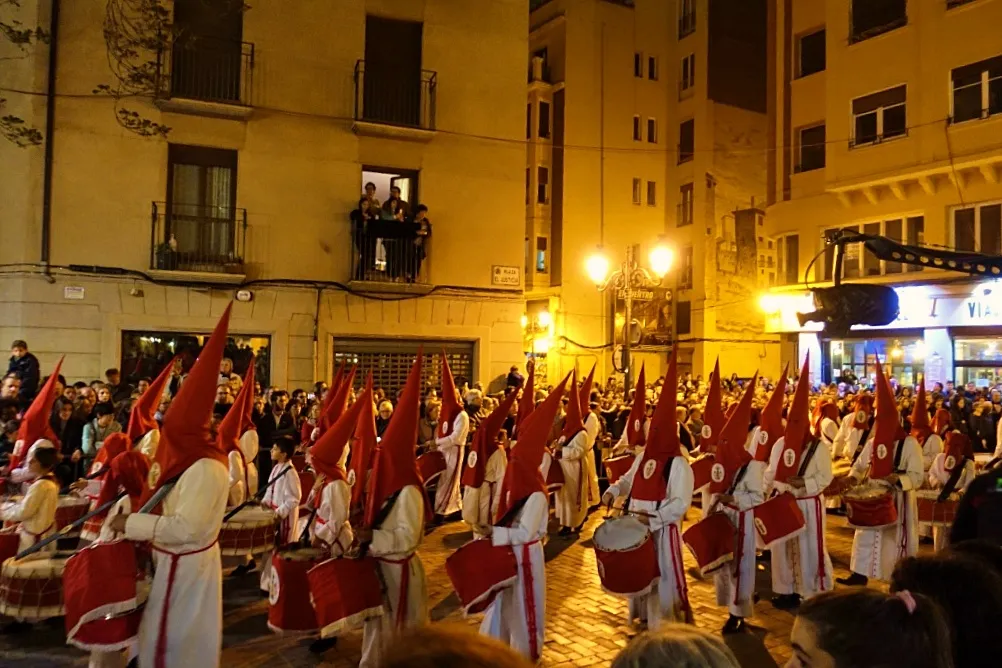
- Drums – the low, slow beat of the drums can be heard before you know there’s a procession coming. It keeps those in the parade in time, and the people carrying the float sway in time with it as they move through the streets. The drums also create such an atmosphere that you can’t help but be drawn in.
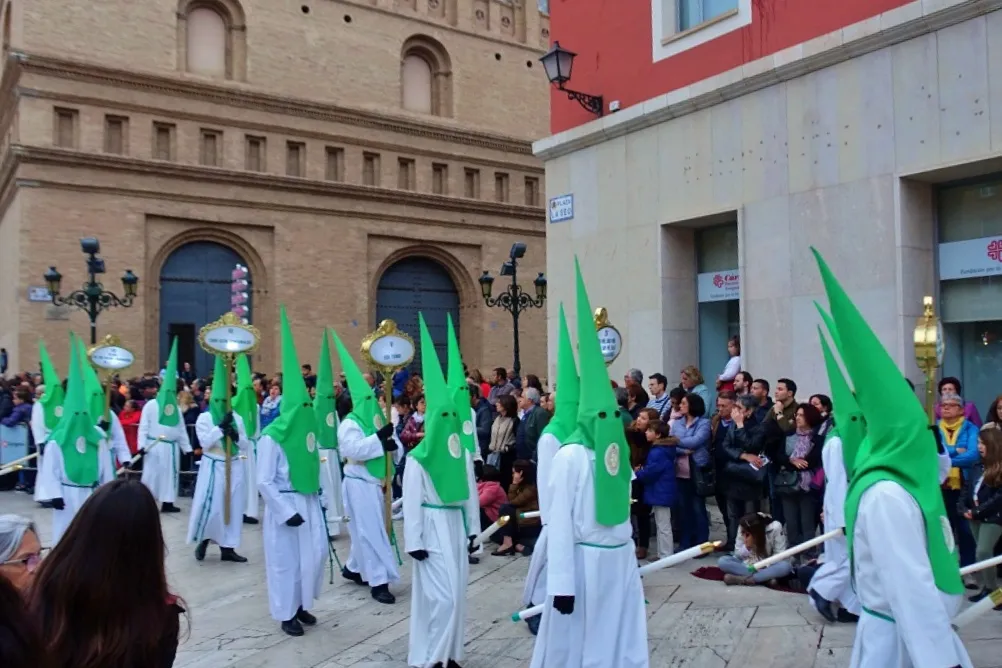
- Gowns and hoods – A full length, long-sleeved gown is worn by most members of the procession, who are also known as Nazarenos. Generally the gowns are white, however some groups opt for darker colours like black or navy. These are then tied around the waist with a piece of robe that is the same colour as the hood. The outfit isn’t complete without the hood, which is worn either straight up in a cone shape, or draped behind the head. Those that are worn without the cone shape traditionally symbolise that that group is more devout.
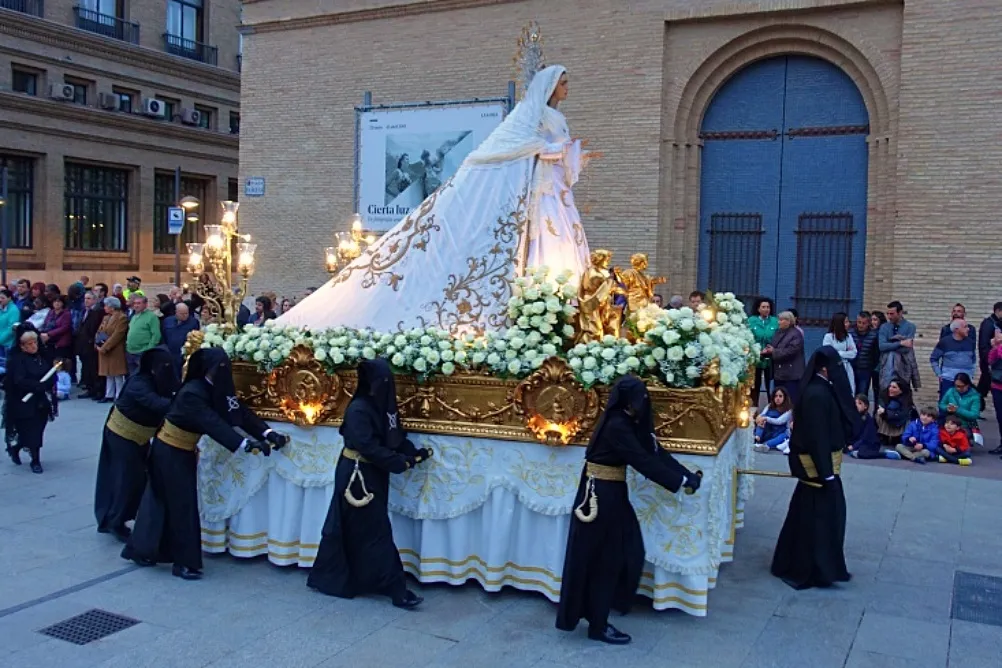
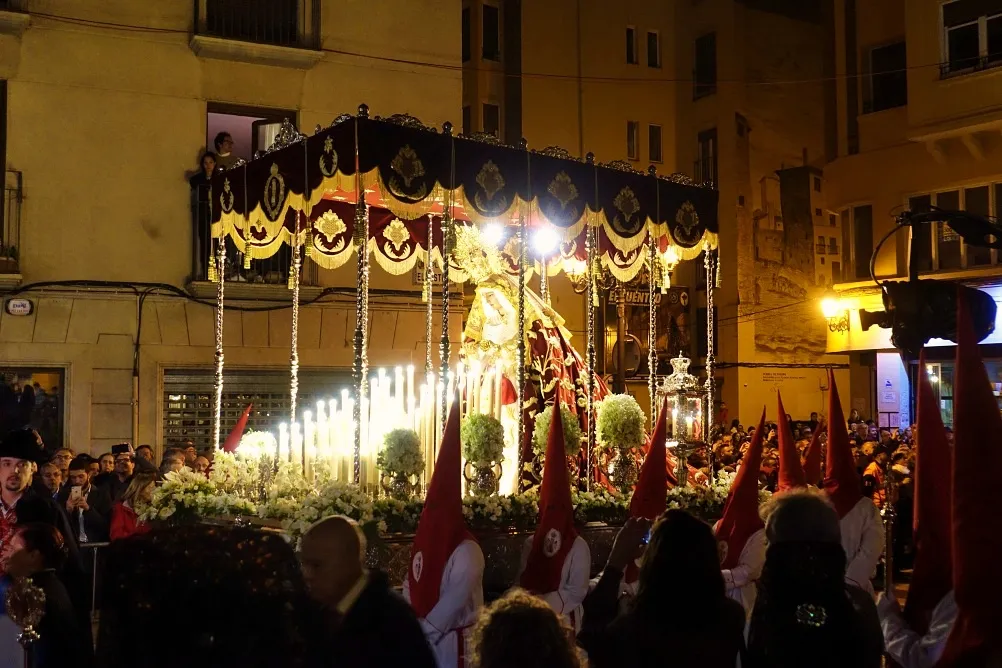
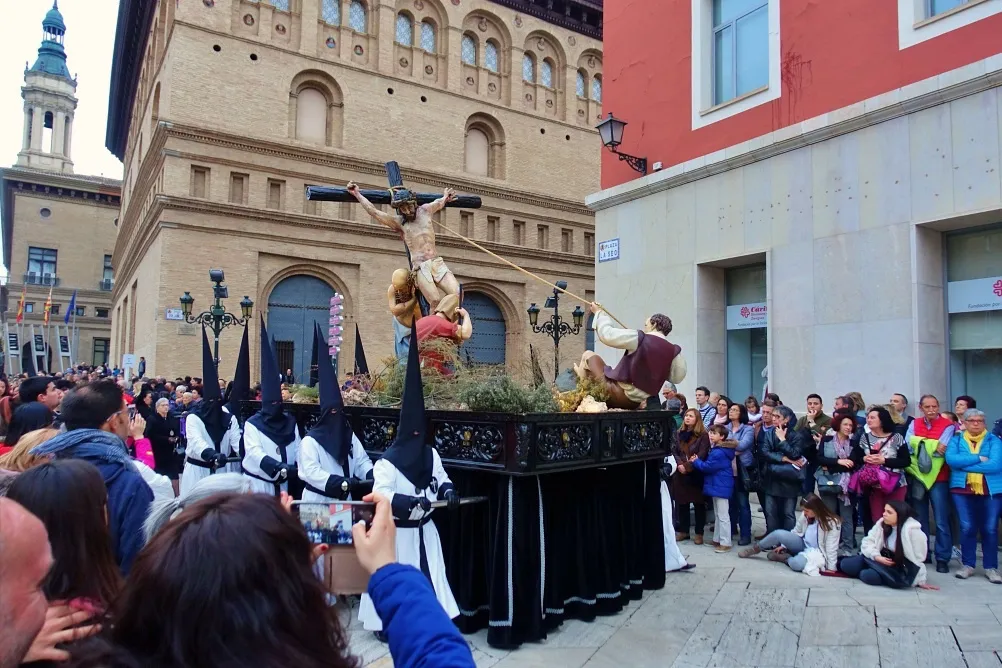
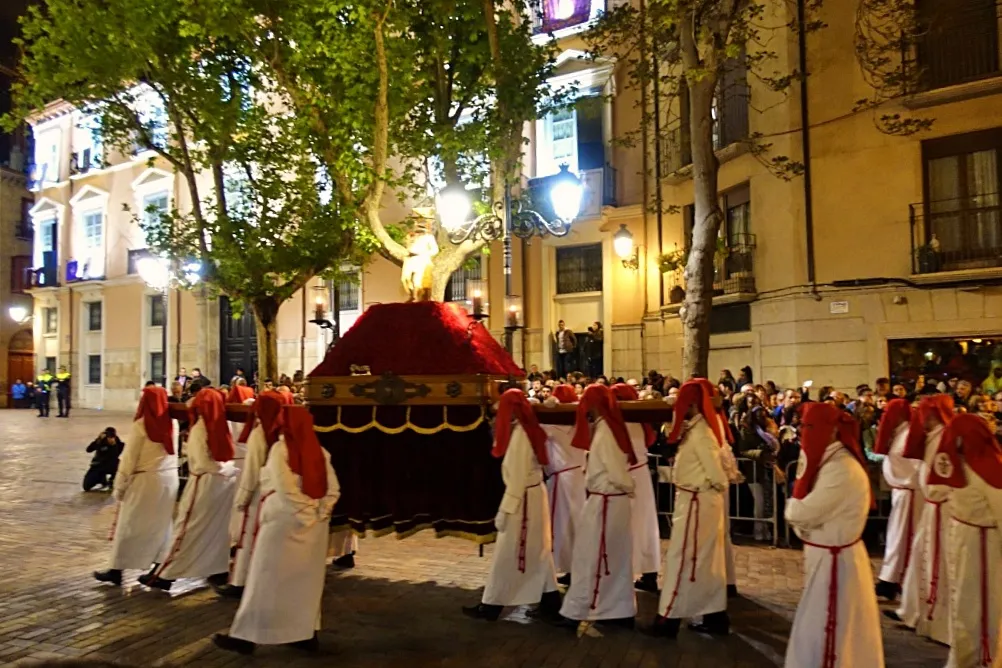
- Floats – Each group of Nazarenos will often carry at least one float, usually with a wooden structure depicting Christ or the virgin Mary. These floats are heavy, and you’ll often see a large number of people carrying it, swaying in time to the drums to ensure everyone is walking at the same pace. For the larger floats, they will often stop to rest or change out the people carrying it.
In the larger processions, women in black follow in a slow walk behind the float. Traditionally it was only men that took part in the Semana Santa parades, but women were welcomed in on the understanding they’d dress in black and walking in mourning and penance. These women will usually be clutching rosary beads, with a black veil draped in front of their face.
There may also be monks and priests joining the parade, as well as representatives from local services such as the police.
Who Takes Part in the Parades?
The parades are made up of different groups of people, identifiable by their different colour hoods. They pass through the parade in their groups, and each group of people will belong to one church or parish.
The parades are made up of all ages and genders, from young children to older members. The floats are usually carried or pushed by adult men due to the weight, but in recent years there have been floats carried solely by women! The drummers are usually also adults due to the weight of the drums and distance they’re carried, especially for such long parades, but sometimes you’ll spot a troop of younger nazarenos with drums.
As a spectator it’s not appropriate to join the parade at any point,
only those who are part of the church or parish take part.
What Happens in La Semana Santa Parades?
The processions through the city can vary in size, from just one group with one float, to all of the participants in one go. As they just walk through the streets, you can find the routes they’ll take online and pick a spot to watch them, or chances are that as you walk around the city you’ll bump into one.
The sound of the drums is a big giveaway that one is close by!
There are certain elements that all parades have, and that is the people in white gowns with hoods on, carrying a float.
When is Semana Santa?
Semana Santa dates 2025: April 13 – April 20
Semana Santa dates 2026: March 29 – April 5
My Semana Santa Experience
I visited Spain at Easter specifically to experience the Semana Santa celebrations. Although I’m not religious, I find a lot of the celebrations of different religions interesting, and this was no different. The original plan had been to visit Seville, but a friend who lives there advised me against it because of the crowds. For a more authentic experience with smaller crowds, Zaragoza seemed to be a good option. After seeing a couple of parades in Madrid, my hopes weren’t high for anything amazing. The Madrid ones had been short, with large crowds.
After arriving in Zaragoza, I found a lot of the city closed. This was the first time I’d even heard of Maundy Thursday; it’s not something a non-religious person in the UK would come across usually. I checked online for the routes the parades would take, and come evening found myself a spot near a church where several parades would be ending at.
It was one of the best introductions to Semana Santa possible.
The crowd was small, and the first sign of any advancing processions was the drums. The slow beat dictates the speed of everyone walking, and as the people came into view I had an unexpected feeling of fear. Fear? That’s not what I’d expected. The sight of people approaching in white gowns with pointed hoods brought to mind images of the KKK. The drums added to the atmosphere, and I had to remember that they had stolen the ‘outfit’ from these parades. Having been taught about the KKK but not about Semana Santa in school, it seems natural but also unfair that that would be the instinctual feeling I had.
After a few minutes the initial unease I felt passed, and I really began to enjoy seeing all the different elements of the parade. I have a couple of friends who explained what the different parts meant, why some had different shape hoods, and that extra knowledge gave me a deeper appreciation of the parades. I’m not religious but it was a real experience to see them and I’d recommend it to anyone who has an interest in it too.
Is it Worth Visiting Semana Santa in Spain?
Absolutely! It’s a unique experience to see the parades moving around the cities, with their different outfits, drums and often extravagant floats that require many people to carry it in a hypnotic swaying fashion. Be prepared for a lot of shops to be closed, so visiting a city that also has a lot of things to see outside will mean you can make the most of your time, but it’s definitely worth going to see!
Being a spectator as the procession passes through a city is more than just watching people walk past carrying something heavy. The sight of all the elements of the parade matched with the low, rhythmic drumming is a real experience. You can’t help but feel the music, and the parade itself is entrancing. Definitely something to experience for yourself.
Is Semana Santa Safe for Solo Travellers?
The parades for Semana Santa take place during the day but also once it gets dark, and there can be large crowds. It’s wise to exercise the usual caution when you’re in a crowd such as keeping valuables and belongings close to you, but I felt safer as a solo female traveller walking around the cities after dark than I usually would because there were so many people out.